
Choosing a water filter
for an Isle of Man home.
Short answer: Start with the problem you want to fix, not the product. Manx mains water is treated and chlorinated before it leaves the works, and Manx Utilities says filters are available to remove chlorine, but adds that it is better to have water with chlorine in it because it protects you from bacteria (Manx Utilities, common water complaints). If taste is the issue, an activated carbon filter is the usual choice. Limescale is a different job, and a softener deals with that. Reverse osmosis (RO) strips out almost everything, and the UK’s Drinking Water Inspectorate (DWI) does not generally consider RO water suitable for drinking and cooking (DWI, domestic water filters and softeners). However simple the filter, it only works if you keep up with its maintenance.
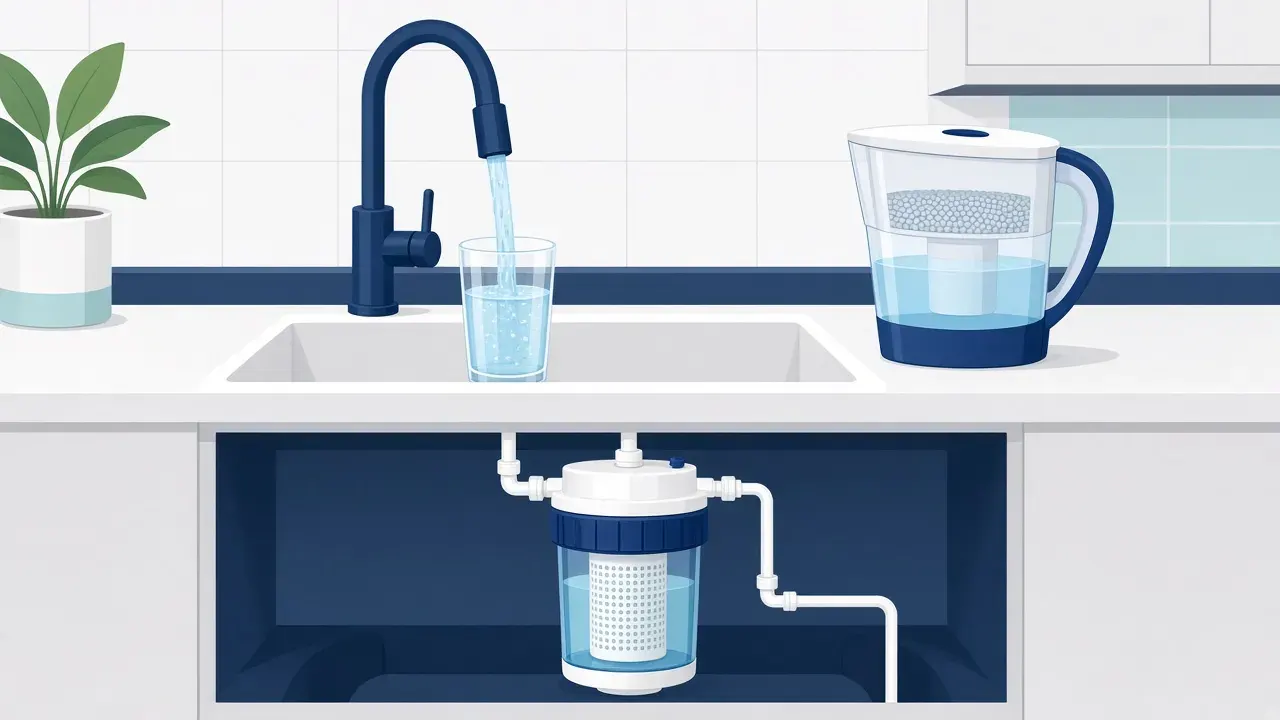
Start with what is in your tap water
The Isle of Man’s raw water is naturally coloured, soft and acidic. At the treatment works the colour from dissolved organic matter, iron and manganese is removed (Manx Utilities). The water is then filtered, and chlorine is added as sodium hypochlorite before it goes into the network (Manx Utilities, chlorine). Our guide to how Manx mains water is treated covers this in more detail.
The DWI’s advice to buyers in England and Wales is to get the drinking water quality report for your supply before buying any treatment unit. That way you can see the legal standards and the levels actually measured, rather than relying on a seller’s claims. The Isle of Man equivalent is to ask Manx Utilities about your area. Until you know what your water contains, you can’t tell whether a filter will do anything useful.
Most people looking at filters fall into one of four groups:
- Taste or smell. Chlorine is the usual cause. Plastic or rubber parts in kettles, hoses and tap washers can also react with chlorine and give TCP-like or metallic tastes (Manx Utilities).
- Limescale. Manx Utilities puts treated mains water at around 40 mg/l as calcium carbonate, which is soft. Read our guide to water hardness by area before paying for a softener.
- Discolouration or bits in the water. These usually point to a fault in the network or your own pipework, and a filter can’t put that right.
- Older pipework. If you are worried about lead, the DWI’s advice is that lead pipes should be replaced as soon as possible, and that running the tap to clear standing water is only a short-term measure (DWI, lead in drinking water).
Activated carbon: for taste and smell
The DWI says removing tastes and odours is the most common reason for buying a filter. For that job, the filter should contain activated carbon. Jug filters, tap-mounted units and under-sink cartridges all use it.
The DWI attaches two warnings. Change the cartridge as often as the manufacturer says. If you don’t, the filter “will cease to be effective and may leach other chemicals or bacteria”. And if small black particles appear in filtered water, they are almost certainly carbon from the filter, not something from your supply.
There is also an Isle of Man point to weigh up. Manx Utilities notes that the pink film sometimes seen on wet bathroom surfaces, caused by an airborne bacterium, “may worsen if customers remove the chlorine from their water by using activated carbon filters” (Manx Utilities). Fitting carbon filtration to drinking water only, rather than the whole house, avoids this.
A free option is worth trying first. Manx Utilities says an uncovered jug of water left in the fridge for a few hours reduces the taste and smell of chlorine. The DWI also calls a covered glass jug in the fridge a more cost-effective choice than a carbon filter. If chilled water tastes fine to you, you may not need a filter at all.
Water softeners: for scale, not for drinking
The DWI calls softeners the most common home treatment system. They use ion exchange, swapping the calcium and magnesium that cause hardness for sodium. The benefits it lists are less scale in hot water systems and better lather, which helps washing machines and dishwashers work efficiently.
The DWI attaches some cautions to softeners:
- Keep an unsoftened supply to the kitchen tap for drinking and cooking, because some softeners add a lot of sodium.
- Softened water can taste and smell different.
- Don’t use artificially softened water to make up baby feeds.
- Water at or below 100 mg/l hardness (as calcium carbonate) is more corrosive to pipework and can dissolve metals such as lead, copper, brass and nickel.
That last point matters on the Isle of Man. Manx mains water is already soft, at around 40 mg/l as calcium carbonate (see our hardness guide), so a softener is rarely worth having on the mains supply.
Softeners also need regular attention. The DWI says to backwash them and top up the salt, and to service them after a property has been empty for a while.
Reverse osmosis: rarely the right answer at home
RO units are often sold as the most complete option. The DWI is cautious about them:
- RO removes most dissolved solids and softens the water. The unit sends 20–30% of the incoming water to drain as waste.
- Water pressure through the unit drops substantially.
- RO changes the natural properties of tap water and “is not generally considered suitable for drinking and cooking”. The World Health Organization recommends adding minerals back if RO water is used for drinking.
- The DWI describes RO as expensive and “generally not a feasible option” for most homeowners. It suggests RO for specialist uses such as photographic processing or hydroponics.
If a seller tells you RO is the only way to make Manx water safe, that is a reason to be wary rather than to buy.
Plumbed-in units: the rules on fitting
Jugs and tap-end filters need no plumbing work. Under-sink filters, whole-house units and softeners connect to the supply, so they count as water fittings.
On the Isle of Man, fittings are covered by the Water Supply Byelaws 2002. The byelaws set requirements for the design, installation and maintenance of plumbing, fittings and appliances, so that water is not wasted, misused or contaminated (Manx Utilities, Water Supply Byelaws). Manx Utilities inspects a proportion of installations, and breaching the byelaws is a criminal offence that can lead to disconnection or prosecution. It also says installation work requires an Authorised Person, and it can give you a list of them (Manx Utilities, commissioning plumbing systems).
The same Manx Utilities page explains that new or altered pipework must be pressure tested and flushed before use, and strongly advises using only the kitchen cold tap for drinking and cooking. That makes the kitchen cold supply the natural place for a drinking-water filter.
Buying sensibly
The DWI’s buying advice applies well on the Isle of Man:
- Buy from a reputable supplier.
- Don’t buy from a door-to-door seller, especially one who offers to “test” your water to show it is contaminated. The DWI says scams of this kind are not uncommon. Cold calling is illegal on the Isle of Man, and the Office of Fair Trading asks people to report it (Isle of Man Government).
- Be wary of claims made online.
- Ask the supplier to show the product meets the water fittings rules.
- Before you buy, check the running costs: replacement cartridges, salt and servicing.
- The DWI suggests considering a service agreement.
A quick decision guide
| Your concern | Usual option | Key maintenance |
|---|---|---|
| Chlorine taste or smell | Chilled jug first, then an activated carbon jug or under-sink filter | Change cartridges on schedule |
| Limescale on kettles and showers | Rarely needed on soft Manx mains; check hardness first | Salt, backwashing, keep a hard drinking tap |
| Discoloured water or debris | Report it and find the cause | No filter needed for a network fault |
| Worry about old pipework | Find out what your pipes are made of and replace if needed | No filter needed |
| Specialist use such as hydroponics | Reverse osmosis | Expect waste water and lower pressure |
Common questions about home filters.
Do I need a water filter on Isle of Man mains water?
For safety, generally no. Manx Utilities treats and chlorinates the water, and says it is better to have water with chlorine in it because that protects against bacteria. Most people who fit a filter do so for taste or scale.
What is the cheapest way to reduce the chlorine taste?
Leave a jug of water in the fridge for a few hours. Manx Utilities says this reduces the taste and smell of chlorine, and the DWI calls it a more cost-effective option than a carbon filter.
Should I drink softened water?
The DWI advises keeping an unsoftened kitchen tap for drinking and cooking, because softeners can add sodium. Artificially softened water should not be used for baby feeds.
Is reverse osmosis water better to drink?
The DWI says RO water is not generally considered suitable for drinking and cooking because it strips out the natural minerals, and it notes the World Health Organization’s recommendation to add minerals back. RO units also waste 20–30% of the water going in.
Who can fit a plumbed-in filter or softener on the Isle of Man?
Manx Utilities says installation work must be carried out by an Authorised Person under the Water Supply Byelaws 2002, and it can provide a list.
Sources, read 30 October 2026.
- Drinking Water Inspectorate, Domestic water filters and softeners (guidance for England and Wales)
- Drinking Water Inspectorate, Lead in drinking water (guidance for England and Wales)
- Manx Utilities, Common water complaints
- Manx Utilities, Chlorine
- Manx Utilities, Water Supply Byelaws
- Manx Utilities, Commissioning plumbing systems
- Isle of Man Government, People urged to be cautious of cold calling traders (9 October 2024)
Manx Pure Water is independent of Manx Utilities and the Drinking Water Inspectorate.