
Private wells and boreholes.
Not the mains report.
A private well or borehole on the Isle of Man is not described by the public mains results. How safe is your private drinking water supply? (not mains) (read 14 October 2026) says private supplies should be checked annually, names the kinds of property it says should be tested each year, and says a single household can ask the Government Laboratory for a test at no charge. Environmental Health Unit (read 14 October 2026) says it is not mandatory for a domestic private supply to be monitored or risk assessed, and that the Water Act 1991 allows for the Department to recover their costs for a requested risk assessment or for monitoring. Those are two official pages. This note does not turn them into one fee or one legal duty. It does not certify a filter, and it is not a test of anyone’s supply.
Preparing for launch. This is a sourced guide, not a test of your tap, a certificate for any filter, or an offer to install.
Not the public mains result.
Government Laboratory drinking-water page (read 14 October 2026) keeps the public supply and private supplies apart. On the public supply it says the Government Analyst has a statutory duty to sample and analyse that supply. It says Manx Utilities provides it to seven defined supply areas, and that laboratory staff sample consumers’ own taps in each of those areas on a regular basis. The private-supply paragraph is separate. It says some properties are not connected to the mains and have a private supply, for example from a borehole. Those supplies are sampled periodically, usually by Environmental Health Officers, and submitted to the laboratory for assessment of chemical and microbiological quality. A report is then issued identifying any deficiencies found. The page points to the private-supply note for the testing arrangements.
The percentages, chlorine ranges and zone names in the 2025/26 Manx Utilities report belong to that public supply. They are summarised in Manx mains water: when a filter helps. They are not copied here onto a well or a borehole. Water hardness by area also gives a private supply no hardness figure. The same laboratory page has a third, shorter subject: water sold in containers is covered by the Food Act 1996 and subordinate legislation, and may be sampled by Environmental Health Officers to check it meets the relevant requirements, including claims on the label. A bottle is not a private well, and this article does not assess a label.
An annual check, and who it names.
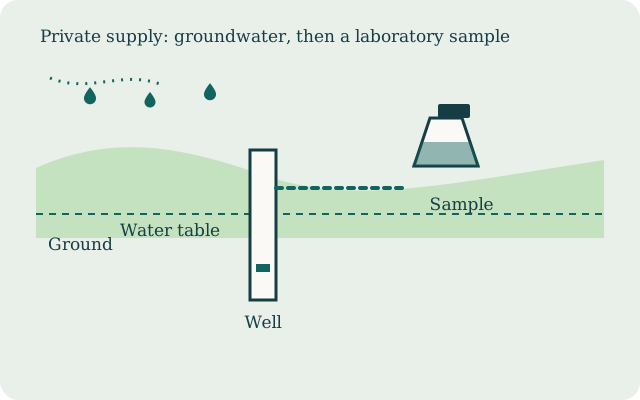
How safe is your private drinking water supply? (not mains) (read 14 October 2026) says rain that is not used by plants moves down through pores and spaces in the rock until it reaches a dense layer. That trapped water is what it says a private supply uses, and what it says a drilled well draws. The page includes a diagram of how that groundwater is created, and links a text description of the groundwater diagram (read 14 October 2026). The description labels a land surface, surface water, an unsaturated zone, a saturated zone, and a line for the approximate water table. It also describes creviced rock and gravel with water in the gaps. That description does not mention a house, a filter, a sample result, or a named place on the Island.
The private-supply page then says that if polluted ground and surface water is consumed, it could cause illness, and it prints this list: E Coli disease, campylobacter, salmonella, cryptosporidium and Guardia. “Guardia” and “E Coli” are the spellings on the page. The same paragraph says polluted ground water can also cause chemical poisoning such as lead and nitrates from fertilisers or septic tanks. It says ground and surface water pollution can be caused by seepage through landfills, failed septic tanks, underground fuel tanks, fertilizers and pesticides, and runoff from urban areas. Those sentences are the laboratory’s account of polluted water. They are not a finding that a particular well is polluted, and they are not a claim that a household filter prevents those illnesses. No such prevention claim is on the page.
The page says it is important that private water supplies are checked annually to ensure that the water is safe for drinking. The properties it says should be tested annually are: properties that produce food and drink to the public; properties which are rented, even for part of the year, with TT or Air B&B as the examples (the page prints “Air B&B”); and, typically, private water systems that serve more than one household. It says there will be a charge for testing commercial premises. It says a single household with a private supply can request a test free of charge by contacting the laboratory direct, on +44 1624 642250 or [email protected]. The page does not print the commercial charge, a list of tests, a bottle or kit, or how long a result takes. This article does not add them.
A second page, with different words.
Environmental Health Unit (read 14 October 2026) has its own private-supplies section. It says the unit samples private water supplies at commercial premises to ensure they are wholesome and safe. For domestic premises it says it is not mandatory for the supply to be monitored or risk assessed, and that you can request a risk assessment and/or monitoring, which it describes as sampling and analysis. It says the Water Act 1991 allows for the Department to recover their costs for these activities. It says that if information indicates the supply is unwholesome or may be a risk to health, the Department may require improvements so the supply meets regulatory standards. The page does not list those standards, and this note does not set out sections of the Act. The cost-recovery sentence is the Environmental Health page’s, including its reference to the Act.
| Question | Government Laboratory | Environmental Health Unit |
|---|---|---|
| What it describes | A private well drawing groundwater. The drinking-water page’s example is a borehole at a property that is not on the mains. | Private supplies at commercial premises, and at domestic premises. It does not describe the geology. |
| Who samples | The drinking-water page says private supplies are sampled periodically, usually by Environmental Health Officers, then submitted to the Government Laboratory. | It says it samples commercial private supplies. For a domestic supply it says you can request monitoring, which it describes as sampling and analysis. |
| How often | The private-supply page says it is important that supplies are checked annually. | No interval is stated. |
| Who is named for a yearly check | Properties that produce food and drink to the public; rented properties, even for part of the year, with TT or Air B&B as the examples; typically, systems that serve more than one household. | Commercial premises are the ones it says it samples. It says monitoring a domestic supply is not mandatory. |
| Charge, in that page’s words | There will be a charge for testing commercial premises. A single household can request a test free of charge by contacting the laboratory direct. | It says the Water Act 1991 allows for the Department to recover their costs for a requested domestic risk assessment and/or monitoring. |
| What you are told afterwards | The drinking-water page says a report is issued identifying any deficiencies found. These pages do not print a parameter list. | If information indicates the supply is unwholesome or may be a risk to health, the Department may require improvements so the supply meets regulatory standards. The page does not list those standards. |
Each cell is that page’s statement. A blank in the sense of “no interval” means the page does not print one. It is not an estimate, a fee, or a result for a property.
The laboratory page offers a free test for a single household and a charge for commercial premises. The Environmental Health page says domestic monitoring is not mandatory and that the Department may recover costs for a request. This page does not decide which sentence applies to a property. The laboratory contact above is a telephone number and an email address. The Environmental Health page’s contact block gives Thie Slieau Whallian, Foxdale Road, St. John’s, IM4 3AS, telephone +44 1624 685894, and counter hours of Monday to Friday 10am to 4pm excluding public holidays. Its email control is labelled “Send Email”. It does not print an email address, so none is invented here.
A sample first. No product claim.
Nothing on these pages describes a kitchen filter, a cartridge, or a reverse-osmosis unit as the check. The check they describe is sampling and a laboratory report, and, on the Environmental Health page, a possible requirement to improve a supply. A taste or odour preference on the public mains is a different subject, covered in the mains article. It does not transfer to a private well.
No treatment model has been selected for Manx Pure Water. This page makes no reduction claim for bacteria, lead, nitrate, or anything else, and it does not certify a product or state a price. The proposed route for a private supply on this website is evidence first, then a specification. That route is not available to book. It is described on private water supplies and water testing. An enquiry on this site is not the way to send a laboratory report to the Government Laboratory.
Short answers, same sources.
Is a private well or borehole covered by the Isle of Man mains water report?
No. Government Laboratory drinking-water page (read 14 October 2026) treats a private supply, for example a borehole, as a property that is not connected to the mains. It says those supplies are sampled separately, usually by Environmental Health Officers. The 2025/26 public-supply figures stay in Manx mains water: when a filter helps. They are not a result for a private well.
How often should a private supply be checked?
How safe is your private drinking water supply? (not mains) (read 14 October 2026) says it is important that private water supplies are checked annually so the water is safe for drinking. Environmental Health Unit (read 14 October 2026) does not state an interval. It says domestic monitoring is not mandatory. This page does not replace either sentence with a schedule of its own.
Which properties does the laboratory say should be tested every year?
Three groups, in the page’s words: properties that produce food and drink to the public; properties which are rented, even for part of the year, with TT or Air B&B as the examples; and, typically, private water systems that serve more than one household. The page does not name towns, and it does not say these are the only supplies that can be tested.
Is a private water test free?
The laboratory page says a single household can request a test free of charge, and that there will be a charge for testing commercial premises. It does not print that charge. The Environmental Health page says the Water Act 1991 allows for the Department to recover their costs for a requested domestic risk assessment and/or monitoring. Ask the office you contact which of those arrangements applies. This site does not take payment for a test.
Is a test compulsory for a single house on a private supply?
Environmental Health Unit (read 14 October 2026) says it is not mandatory for a domestic supply to be monitored or risk assessed. The same page says you can request a risk assessment and/or monitoring. The laboratory page still says an annual check is important, and it offers the single-household request. “Not mandatory” is the Environmental Health sentence. It is not a finding that an untested supply is safe.
Will a kitchen filter make a private supply safe?
These pages do not say that. They describe sampling, a laboratory report, and, where the Environmental Health page says the supply is unwholesome or may be a risk to health, a possible requirement to make improvements. No filter is named or certified here. A cartridge chosen for mains taste is a different question.
Who do I contact to arrange a test?
The laboratory page says to contact the Government Laboratory on +44 1624 642250 or [email protected]. The Environmental Health page gives +44 1624 685894 and the address at Thie Slieau Whallian, St. John’s, and a “Send Email” link rather than a printed address. Manx Pure Water does not book the sample and does not hold a result for a property.
Read on 14 October 2026.
Every statement above about private supplies is taken from the Isle of Man Government pages below. They were read on 14 October 2026. The mains and hardness articles are linked only to show what they do not cover. Manx Pure Water is independent of the Government Laboratory, the Environmental Health Unit, the Department of Environment, Food and Agriculture, and Manx Utilities. Nothing here certifies a product, states a price, or reports a sample from a property.
- Government Laboratory: How safe is your private drinking water supply? (not mains) — annual check, who should be tested, commercial charge, free single-household request, telephone and email
- Government Laboratory: text description of the groundwater diagram — land surface, surface water, unsaturated and saturated zones, water table
- Government Laboratory: Drinking water quality — public supply and private supplies kept apart; boreholes; Environmental Health sampling; Food Act 1996 for water sold in containers
- Environmental Health Unit: private water supplies — commercial sampling, domestic monitoring not mandatory, Water Act 1991 cost recovery, possible requirement to improve a supply; contact block
The shorter notes on water testing and private water supplies are this site’s service pages. They are not a laboratory report.