
Where does Isle of Man tap water
come from?
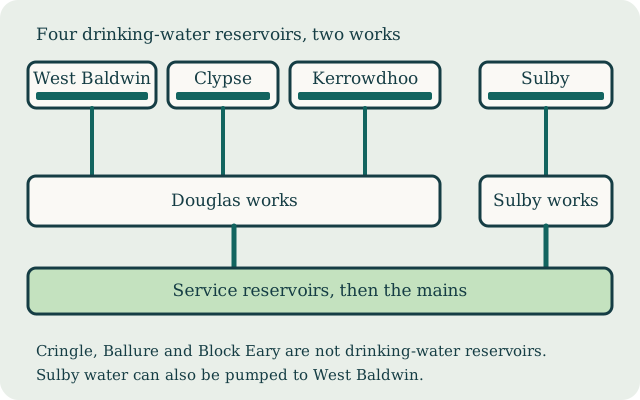
Public drinking water on the Isle of Man starts in reservoirs. impounding reservoirs page (read 18 October 2026) says Manx Utilities owns seven impounding reservoirs, and that four are currently operational: West Baldwin, Sulby, Clypse and Kerrowdhoo. Those four provide raw water to two treatment works, at Douglas and Sulby. Cringle and Ballure are no longer used for drinking water. Block Eary is described as a hydroelectric source, not a drinking-water reservoir. This note is not a result for a kitchen tap, and it does not certify a filter.
Preparing for launch. This is a sourced guide, not a test of your tap, a certificate for any filter, or an offer to install.
Which reservoirs supply drinking water?
impounding reservoirs page (read 18 October 2026) says Manx Utilities owns 7 impounding reservoirs, “4 of which are currently operational; West Baldwin, Sulby, Clypse and Kerrowdhoo.” Those four “provide raw water to the Island’s 2 water treatment works at Douglas and Sulby.” The same opening says Cringle and Ballure “are no longer used for drinking water supply” and that Block Eary “supplies water for hydroelectric power generation.”
| Reservoir | What that page says it is for | Capacity on its stats line | Drinking-water supply zone on its stats line |
|---|---|---|---|
| West Baldwin | Operational. Completed in 1904. Sometimes known locally as Injebreck Reservoir. | 1,290,000m³ | Douglas, Onchan and the south of the Island. |
| Clypse | Operational. Stats line: completed 1878. Upper reservoir on the Groudle River, above Onchan. The page says its normal mode is to feed water down into Kerrowdhoo. | 131,000m³ | With Kerrowdhoo: both supply Douglas, Onchan and the south of the Island. |
| Kerrowdhoo | Operational. Stats line: completed 1893. The lower reservoir. With Clypse, it supplies raw water to Douglas Water Treatment Works. | 221,000m³ | With Clypse: both supply Douglas, Onchan and the south of the Island. |
| Sulby | Operational. Completed in 1982. The page calls it the largest and newest. Piped to Sulby works. It can also be pumped to West Baldwin. | 4,620,000m³ | St Johns and Peel in the west, Kirk Michael, Ballaugh, Andreas, Bride and Ramsey in the north and Laxey, on the east coast. |
| Cringle | Not a drinking-water reservoir. Decommissioned in 2008, after Douglas works opened. The page says it is now used solely for recreation. | 125,000m³ | “Cringle Reservoir is not currently a drinking water resource reservoir.” |
| Ballure | Not used as a raw-water resource since 2005, after the old treatment works closed. Used solely for recreation. Still owned by Manx Utilities. | 70,000m³ | “Ballure Reservoir is not currently a drinking water resource reservoir.” |
| Block Eary | Not a drinking-water reservoir. Completed in 1945. Used principally for hydroelectric power, with Sulby Reservoir. | 50,000m³ | “Block Eary Reservoir is not currently a drinking water resource reservoir.” |
Capacity is the stats-line figure, in the unit that line prints. A zone cell is that line’s wording. It is not a sample from a tap, and it is not a hardness result.
West Baldwin, Clypse and Kerrowdhoo are the Douglas side of that split. Clypse is the upper reservoir on the Groudle River, above Onchan. The page says that after Kerrowdhoo was completed, “the normal mode of operation of Clypse Reservoir became to feed water down into the new lower reservoir.” It then says the two reservoirs supply raw water to Douglas Water Treatment Works. Their shared stats line, and West Baldwin’s own line, name the same zone: Douglas, Onchan and the south of the Island. West Baldwin is also “sometimes known locally as Injebreck Reservoir.”
Sulby is the other route. The page calls it the largest and newest reservoir on the Island, completed in 1982. “Water from the reservoir is piped to Sulby Water Treatment Works where it is treated and distributed to the population in the north of the Island.” The same paragraph says Sulby water “can also be pumped to West Baldwin Reservoir, which supplies water to the Douglas area and the south of the Island via Douglas Water Treatment Works.” The stats line further down names places: “St Johns and Peel in the west, Kirk Michael, Ballaugh, Andreas, Bride and Ramsey in the north and Laxey, on the east coast.” Dalby is not in that list.
On Cringle, the page says it “formerly fed Ballagawne Water Treatment Works” before that works closed in early 2008. With Douglas works opening in 2008, Cringle “was decommissioned from being a public water supply reservoir later that year.” The page says the drinking water supply for the south “is now provided by water from West Baldwin, Clypse and Kerrowdhoo Reservoirs which is treated at Douglas Water Treatment Works,” and that Cringle “is now used solely for recreational purposes.” The Cringle paragraph does not mention the Sulby pump. Ballure “has not been used as a raw water resource since 2005 following the closure of the old treatment works” and “is now used solely for recreational purposes.” It “remains under the ownership of Manx Utilities.” Block Eary’s stats line says it is not currently a drinking water resource reservoir. The page says it is used principally for hydroelectric power generation, in conjunction with Sulby Reservoir.
What’s in our drinking water? (read 18 October 2026) says that on the Isle of Man raw water collects in reservoirs and stays naturally soft, because it passes over less porous rock. After treatment, it says, Manx drinking water remains soft at around 40 mg CaCO3/l total hardness (16 mg Ca/l). Which named areas have no hardness figure of their own is in Water hardness by area on the Isle of Man. The 2025/26 report’s area-of-supply sentence, which does name Dalby, and that report’s count of service reservoirs, are in the same article, from a reading on 13 October 2026. This note does not re-read the PDF, and it does not add Dalby to the Sulby stats line.
Where is that water treated?
water treatment works page (read 18 October 2026) says there are 2 operational water treatment works, at Sulby and Douglas. It says a diagram of the basic water treatment process is shown below that sentence. The page does not print those steps as text, so this note does not supply them. It says a group tour of Douglas Water Treatment Works can be arranged. It does not print a telephone number or a form for that tour.
What does the Douglas works section say?
Douglas works “Opened in May 2008” and “provides treated water to Douglas, Onchan and the south of the Island.” West Baldwin, Clypse and Kerrowdhoo “supply raw water to the works.” It replaced Glencrutchery works, which “has since been demolished and the site is now owned by the Department of Education.” Glencrutchery was “Built in 1933,” “a single stage works, treating up to 18 megalitres of water daily for residents in the Douglas area.” The design sentence is printed without a full stop: “Douglas Water Treatment Works is designed to treat up to 37 megalitres of water a day, supplying 70% of the Island’s population”. The 37 megalitres and the 70% belong to that sentence, about Douglas works. The Sulby section does not give a design capacity.
What does the Sulby works section say?
Sulby works “Opened in October 2005”. The heading is “Sulby Water Treatment Works”. The sentence spells it “Sulby Water Treatment works” and says it “provides treated water to the north of the Island.” Sulby Reservoir “supplies raw water to the works.” This page does not print the town list from the reservoir stats line. An energy recovery system was installed in February 2013. Raw water “is piped from Sulby Reservoir to the treatment works and passes through a turbine” and then “passes through the treatment works and onto our customers.” “The turbine provides up to 50% of the electricity required to run Sulby Water Treatment Works.” That 50% is electricity for the works. It is not a share of the Island’s water, and it is not the separate hydro arrangement the reservoirs page describes at Block Eary.
What volumes does the about page give?
about-water page (read 18 October 2026) says that each year Manx Utilities collects, treats, stores and distributes over 10,000 megalitres of water, and takes over 3,600 water quality samples. In winter it supplies an average of 29 megalitres a day to over 50,000 connections, “through a network of over 1,800 km of mains, over an approximate area of 250 square miles.” Summer demand “rises to 35 megalitres per day.” The operational list on that page is 4 impounding reservoirs, 2 water treatment works, 20 pumping stations, 27 service reservoirs, and over 1,800 kilometres of water mains. The four reservoirs match the four the reservoirs page calls operational. The list does not name the 20 pumping stations, and this note does not open a pumping-stations page. The 37 megalitres at Douglas works and the 35 megalitre summer demand are left as separate sentences. This page does not subtract one from the other. The sample count printed in the 2025/26 report is left in the mains article. This note does not re-read that PDF.
Where does treated water go next?
service reservoirs page (read 18 October 2026) says “Treated water suitable for drinking is stored in service reservoirs.” It says not to confuse them with raw-water impounding reservoirs. They “need to be totally enclosed and protected from outside contamination by ground and surface water, animals, and vegetation.” The sizes it gives run from “small covered tanks storing only 22,730 litres” to “large concrete structures holding 22.7 megalitres.” It lists three jobs: a reserve against interruptions from pumping, treatment plant or mains failure; meeting fluctuating demand; and stable mains pressure to minimise burst mains. “We own 39 service reservoirs, 27 of which are currently operational.” The about page’s operational list also says 27 service reservoirs. Neither page names the 27 sites. The report’s count is the one already left in the hardness article.
Government Laboratory drinking-water page (read 18 October 2026) says the public water supply “is provided by Manx Utilities, to 7 defined supply areas,” and that laboratory staff sample consumers’ taps in each of those areas. The page does not name the seven areas, and it does not name these reservoirs. This note does not turn two treatment works into those seven names. The same page keeps a private well or borehole apart from the mains. That supply is the subject of Private wells and boreholes on the Isle of Man.
Does a kitchen filter change the source?
None of these pages names a kitchen filter, a cartridge or a reverse-osmosis unit on the route from reservoir to tap. The works page says the water is treated, then distributed. The service-reservoir page says treated water is stored, then the about page describes the mains. A filter at one sink would sit after that route, on the outlet it is connected to. No model has been selected for Manx Pure Water. This page makes no reduction claim and states no price.
They do not say that a home needs a filter before the water can be drunk. The mains article, linked below, is the note on when a filter helps. An enquiry on this website is not a message to Manx Utilities, and it is not a booking for the Douglas works tour.
Short answers, same sources.
Where does Isle of Man tap water come from?
On the public supply, from reservoirs, then from one of two treatment works. impounding reservoirs page (read 18 October 2026) says four impounding reservoirs are currently operational: West Baldwin, Sulby, Clypse and Kerrowdhoo. They feed the works at Douglas and Sulby. Manx Utilities owns seven impounding reservoirs. Cringle, Ballure and Block Eary are not current drinking-water reservoirs. That is a description of the public supply. It is not a result for one kitchen tap.
Which reservoirs supply Douglas and the south?
The reservoirs page gives Douglas, Onchan and the south as the zone for West Baldwin, and the same zone for Clypse and Kerrowdhoo together. water treatment works page (read 18 October 2026) says those three supply Douglas works, which provides treated water to Douglas, Onchan and the south. Sulby water can also be pumped to West Baldwin, which the reservoirs page says supplies the Douglas area and the south via Douglas works. Cringle was decommissioned in 2008. The page says the south is now supplied from West Baldwin, Clypse and Kerrowdhoo, treated at Douglas works.
Where does water for Peel, Ramsey, Laxey or the north come from?
Sulby Reservoir is piped to Sulby works. The works page says that works provides treated water to the north of the Island. The reservoirs page says the water is distributed to the population in the north, and its stats line names St Johns, Peel, Kirk Michael, Ballaugh, Andreas, Bride, Ramsey and Laxey. That line does not name Dalby. Ballure has not been a raw-water resource since 2005. The 2025/26 report’s area sentence, which does name Dalby, is in the hardness article, from a reading on 13 October 2026. This note does not re-read the report.
How much water do these pages say is supplied?
about-water page (read 18 October 2026) says over 10,000 megalitres a year, a winter average of 29 megalitres a day, and summer demand of 35 megalitres a day, to over 50,000 connections through over 1,800 km of mains. Douglas works is designed to treat up to 37 megalitres a day, and the same sentence says it supplies 70% of the Island’s population. The Sulby works section gives no design capacity. The 50% figure on that page is electricity for the Sulby works turbine, not a share of the water. These figures are not combined on this page.
How many service reservoirs are there?
service reservoirs page (read 18 October 2026) says Manx Utilities owns 39 service reservoirs, 27 of which are currently operational. The about page’s operational list also says 27. Neither page names them. They store treated water and are not the raw-water reservoirs. A different count in the 2025/26 report is left in the hardness article. This note does not re-read that PDF.
Does a home water filter change where the water comes from?
No. These pages do not mention a jug, a cartridge or a reverse-osmosis unit. The route they describe is reservoir, treatment works, service reservoir, then the mains. No model is certified here, and no price is stated. A private well or borehole is a different supply, in Private wells and boreholes on the Isle of Man.
Read on 18 October 2026.
Every reservoir, works, volume and zone above is taken from the pages below. They were read on 18 October 2026. Where one sentence says “the north” and another names towns, both are kept. Where one page says 27 operational service reservoirs and the 2025/26 report’s count differs, the report is not re-read. Manx Pure Water is independent of Manx Utilities and the Isle of Man Government Laboratory. Nothing here certifies a product, states a price, or reports a sample from a tap.
- Manx Utilities: Impounding reservoirs — seven owned, four operational; the stats lines; Cringle decommissioned in 2008; Ballure unused as raw water since 2005; Block Eary for hydroelectric power; the Sulby pump to West Baldwin
- Manx Utilities: Water treatment works — Douglas, opened May 2008, up to 37 megalitres a day and 70% of the population; Sulby, opened October 2005, the north; the 2013 turbine and up to 50% of the works’ electricity
- Manx Utilities: Service reservoirs — treated water stored, enclosed; 22,730 litres to 22.7 megalitres; 39 owned, 27 operational
- Manx Utilities: Water — over 10,000 megalitres a year; 29 and 35 megalitres a day; over 50,000 connections; over 1,800 km of mains; the operational list, including 20 pumping stations and 27 service reservoirs
- Manx Utilities: What’s in our drinking water? — raw water collects in reservoirs and stays naturally soft; around 40 mg CaCO3/l after treatment
- Isle of Man Government Laboratory: Drinking water quality — public supply provided by Manx Utilities to seven defined supply areas, unnamed on the page; private supplies kept separate
The mains article is the sourced account of the 2025/26 results. This note is only where the public supply comes from.