Is Isle of Man tap water
fluoridated?
Manx Utilities says none of the water it supplies is artificially fluoridated, and that fluoride has never been added to drinking water on the Isle of Man. The level it gives is around 0.05 mg/l of natural fluoride. Isle of Man Public Health’s fluoridation FAQ gives the same description of the supply. A later Public Health page, still worded this way on 16 October 2026, says there are currently no plans to add fluoride, and that the Council of Ministers has confirmed no policy position or further action at this time. This note is not a test of a kitchen tap, a dental recommendation, or a certificate for a filter.
Preparing for launch. This is a sourced guide, not a test of your tap, a certificate for any filter, or an offer to install.
What the pages say is in the water.
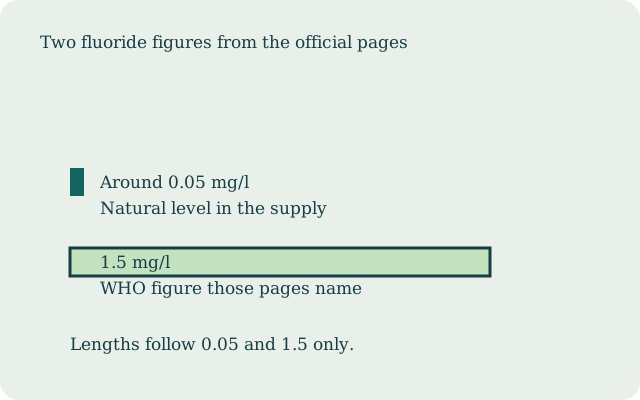
Fluoride and artificial fluoridation (read 16 October 2026) is a short page. Its first sentence, set in bold, says none of the water Manx Utilities supplies is artificially fluoridated. It says fluoride is naturally occurring and typically comes from soils and rock, and that it occurs naturally at very low levels in drinking water. The level it prints is “around 0.05 mg/l”. The limit it names is “The World Health Organisation limit for fluoride is 1.5mg/l.” It says fluoride is artificially added in some parts of the UK, and in other countries, “because it is considered to have benefits in reducing tooth decay.” That sentence is about those other supplies. It is not a result for a glass of Manx water. The page says adding fluoride would have to be a decision by health experts, not by Manx Utilities, and that it could be added only if the Department of Health and Social Care requests it following public consultation and approval from the Council of Ministers. Its last sentence says fluoride has never been added to drinking water in the Isle of Man. What’s in our drinking water? (read 16 October 2026) repeats that none of the water supplied is artificially fluoridated, and links to the fluoride page.
Water Fluoridation FAQs (read 16 October 2026) is the file linked from the Public Health page. On the supply itself it agrees, in its own words: Manx water “currently contains very low levels of natural fluoride (around 0.05 mg/l), and drinking water is not artificially fluoridated.” It calls 1.5mg/l “The World Health Organization guideline value”, spelling Organization with a z. Later in the same file, the skeletal-fluorosis answer calls 1.5 mg/L “a maximum level” and says that value “is intended to maximise the oral health benefits, and be protective of public health, including fluorosis.” Those are three wordings from two publishers. This note does not collapse “limit”, “guideline value” and “maximum level” into one legal standard, and it does not convert 0.05 mg/l into a dose for a person.
| Question | Manx Utilities fluoride page | Public Health Water Fluoridation FAQs |
|---|---|---|
| Is fluoride added to the supply? | The opening sentence is in bold: “None of the water we supply is artificially fluoridated.” The last sentence reads “Fluoride has never been added to drinking water in the Isle of Man”. The page prints no full stop after that sentence. | “drinking water is not artificially fluoridated.” |
| What level does the page give? | “very low levels of natural fluoride; around 0.05 mg/l.” It says fluoride is naturally occurring and typically comes from soils and rock, and that it occurs naturally at very low levels in drinking water. | “very low levels of natural fluoride (around 0.05 mg/l)”. It also says all natural water contains some level of natural fluoride. |
| What 1.5 figure does it name? | “The World Health Organisation limit for fluoride is 1.5mg/l.” The page prints “Organisation” and “1.5mg/l” with no space. | Near the start: “The World Health Organization guideline value for fluoride is 1.5mg/l.” In the skeletal-fluorosis answer: “a maximum level of 1.5 mg/L of water.” |
| Where else is fluoride added? | “In some parts of the UK, and in other countries around the world”, “because it is considered to have benefits in reducing tooth decay.” | “In many parts of the world, including some parts of England”, added “to increase the level of fluoride in line with this guideline value.” |
Each cell is that source’s wording. “Around 0.05 mg/l” is their description of the water Manx Utilities supplies. It is not a sample from a kitchen tap, and it is not a figure for one town.
The 2025/26 drinking-water report’s works table is a separate document. What that table printed for fluoride is already set out in Manx mains water: when a filter helps, from the report read on 13 October 2026. This note does not add a new reading of that PDF. The 0.05 mg/l figure used here is the one on the two pages read on 16 October 2026. Neither page gives a fluoride figure for Douglas, Peel, Ramsey or any other town. What’s in our drinking water? (read 16 October 2026) says water quality for your area can be supplied on request. Manx Pure Water does not hold that result.
Explored before. No current plan.
The supply description and the question of adding fluoride are different sentences, and the documents do not all speak from the same moment. Water Fluoridation FAQs (read 16 October 2026) says the possibility was last explored in 2008 and discussed further in 2014, and that “at this time, it was decided against.” The same file still talks about the research paper as work to come. It says many places already add fluoride, “so we will study any peer-reviewed research”, and that the paper “will be published on the Register of Business in the coming months.” It also says the aim would be evidence for Tynwald on whether fluoridation “would be a more efficient and effective way of preventing tooth decay in children than targeted fluoride varnish application.” Those are the FAQ’s forward-looking sentences. They are not a decision dated 16 October 2026.
Water Fluoridation Report laid before Tynwald (read 16 October 2026) is dated Thursday, 7 March 2024. It says the Rapid Review Research Paper and Report: Water Fluoridation has been published for laying before Tynwald, as part of Tynwald-approved recommendations for reducing tooth decay and dental caries in children. It says the Council of Ministers has confirmed that no policy position or further action on water fluoridation will be taken at this time. Exploring the fluoridation of water as a public health intervention (read 16 October 2026) repeats that confirmation, and says “there are currently no plans to do this.” The page’s link on the recommendations sentence is Tynwald paper 2023-GD-0030. Its link on the sentence that the research paper is on the Register of Business is Tynwald paper 2024-GD-0024. The news release links the 2024 paper as well. This article does not restate those two PDFs. It uses the sentences on the pages that link them.
| Source | What it says |
|---|---|
| 2008 and 2014, as the FAQ describes them | “The possibility of fluoridating Manx water was last explored in 2008, and discussed further in 2014. At this time, it was decided against.” |
| The FAQ’s own timing | It says the research paper “will be published on the Register of Business in the coming months.” That sentence looks forward. It is an earlier document than the March 2024 release. |
| News release, Thursday 7 March 2024 | The Rapid Review Research Paper and Report has been published for laying before Tynwald. “It has been confirmed by the Council of Ministers that no policy position or further action on water fluoridation will be taken at this time.” |
| Public Health page, still worded this way on 16 October 2026 | The same Council of Ministers confirmation. Separately: “there are currently no plans to do this.” |
| Who the Manx Utilities page says could add it | “Adding fluoride to water is a decision that would have to be made by health experts, not by Manx Utilities”. It could be added only if the Department of Health and Social Care requests it, following public consultation and approval from the Council of Ministers. |
The FAQ’s “will be published” sentence and the 7 March 2024 sentence that the paper has been published are both kept. This page does not treat the FAQ as a live plan to fluoridate.
The FAQ answers a question headed “Will it cost £2 million to add fluoride to our water?” The answer does not adopt £2 million. It says Manx Utilities provided initial estimates for setting up and for ongoing costs, “subject to further investigation through a feasibility study.” It says the initial cost “could be in the region of £1-1.5 million, with ongoing costs of approximately £50-£75,000 per year.” It says water fluoridation has been found to be cost effective in other countries, and that accurate return on investment would need further work. That is an estimate inside a file that still expects a study. The March 2024 release and the Public Health page then record no further action and no current plans. The figures are not a price for a home filter, and they are not a confirmed public spend.
Read the FAQ for what Public Health wrote while the paper was still to come. Read the 7 March 2024 release, and the Public Health page as it stood on 16 October 2026, for the decision afterwards. This page does not promote either document into a plan to fluoridate the supply.
What the FAQ says, and where it stops.
The FAQ’s answers about tooth decay are about fluoride and about fluoridation schemes. They are not printed as a measurement of today’s Manx tap water. Water Fluoridation FAQs (read 16 October 2026) says fluoride “is a mineral that helps to prevent tooth decay”, and that brushing thoroughly with fluoride toothpaste twice a day “is one of the most effective ways of preventing tooth decay.” It says children and adults on the Isle of Man “are recommended to use family fluoride toothpaste (1,350 - 1,500 parts per million fluoride – ppmF) for maximum cavity control.” That recommendation is the FAQ’s. It is not a product selected by Manx Pure Water.
On schemes, the FAQ says water fluoridation “is understood to reduce levels of decay in primary teeth by 35% and in permanent teeth by between 26-70%.” The same answer says dental caries has reduced worldwide in areas both with and without systematic fluoridation schemes. It says that reduction is due to a combination of factors, “including the more widespread use of fluoride bases toothpastes.” “Fluoride bases toothpastes” is the wording in the file. It then says “tooth decay is still seen less is areas that are fluoridated compared to non-fluoridated areas (with low levels of natural fluoride)”, and that where schemes have been withdrawn, levels of decay have risen. “Less is areas” is also the wording in the file. The Island supply is in the non-fluoridated group that sentence describes: the same FAQ says Manx drinking water is not artificially fluoridated and has very low natural fluoride. The 35% and 26–70% figures are not printed as the effect of the water now coming out of a Manx tap.
On harm, the FAQ says “very high levels of fluoride can be toxic”, and that “no significant health risks have been found in relation to water which is fluoridated within the recommended levels.” It says “both too little, and too much, fluoride causes adverse health effects.” Its summary sentence is: “Overall there is no evidence of health related harms for any age-group following water fluoridation, when water is fluoridated within the recommended levels.” On skeletal fluorosis it says prolonged exposure to high concentrations can cause skeletal fluorosis, which can eventually result in joint stiffness and pain, and it describes the usual settings as groundwater naturally rich in fluoride, particularly in warm climates, high-fluoride water used for food or irrigation, and fluoride-rich coal. On dental fluorosis it says this can sometimes occur if a child’s teeth are exposed to too much fluoride while they are developing, that it “is a cosmetic condition, not a disease”, and that most cases result from supplements or from swallowing fluoride toothpaste “when the water they drink is already fluoridated.” A separate answer says a Public Health questionnaire found that the majority of children in Reception and Year 1 drink more than three glasses of tap water a day, and that those results “indicate that children consume enough tap water to make water fluoridation effective.” That indication is about a scheme. It is not a statement that the current unfluoridated supply has that effect.
Water Fluoridation Report laid before Tynwald (read 16 October 2026) quotes Interim Director of Public Health Protection Caryn Cox. She says the research paper “presents evidence from a range of sources to help identify any risks and benefits”, and that “The evidence shows that fluoride, when used in appropriate amounts, is very effective in reducing tooth decay and dental caries.” The same remarks quote the four UK Chief Medical Officers’ 2021 statement, which the release links as statement on water fluoridation from the UK Chief Medical Officers: “It should be seen as a complementary strategy, not a substitute for other effective methods of increasing fluoride use.” The release says brushing thoroughly with fluoride toothpaste is one of the most effective ways of preventing tooth decay, and is the focus of the Smile of Mann supervised toothbrushing programme. It also lists other oral-health work: Smile of Mann in early years, primary schools and Specialist Provision Centres; an amalgamated implementation plan for the dental strategy and the oral health strategy for children aged 0–11; an epidemiological study of five-year-olds planned for April; and a healthy home habits campaign. Those items are the release’s. They are not a sample of tap water. The quoted sentence about fluoride “in appropriate amounts” is not a finding that the published level of around 0.05 mg/l has that effect.
The FAQ also answers questions on pineal-gland calcification, the chemicals used for fluoridation schemes in England, randomised trials, human rights, practice in Europe, biosphere status, fluoride drops, Prozac, IQ, cancer, fractures, and livestock. On the chemicals, it says fluoridation in England uses hexafluorosilicic acid or disodium hexafluorosilicate. It does not say those chemicals are added on the Isle of Man. The Manx Utilities page says fluoride has never been added here. The other answers stay in the PDF. This page does not restate them as a result for a kitchen tap or as a reason to fit a filter.
Not part of these pages.
None of these pages describes a kitchen filter, a cartridge, or a reverse-osmosis unit as something that changes fluoride. A carbon filter discussed for chlorine taste, in If tap water looks or tastes different, is a different subject. No treatment model has been selected for Manx Pure Water. This page makes no reduction claim for fluoride or for anything else, and it does not certify a product or state a price.
A private well or borehole is outside the Manx Utilities sentence “the water we supply”. The laboratory and Environmental Health pages for that supply are cited in Private wells and boreholes on the Isle of Man. An enquiry on this website is not a message to Manx Utilities, Public Health, or the Department of Health and Social Care.
The published description is that public drinking water is not artificially fluoridated, at around 0.05 mg/l of natural fluoride, and that there is no current plan to add fluoride. A home filter is not part of that description. Water Fluoridation FAQs (read 16 October 2026) and Water Fluoridation Report laid before Tynwald (read 16 October 2026) are the sources for the tooth-decay sentences above. Manx Pure Water does not add a dental recommendation of its own.
Short answers, same sources.
Is Isle of Man tap water fluoridated?
No. Fluoride and artificial fluoridation (read 16 October 2026) says none of the water Manx Utilities supplies is artificially fluoridated, and that fluoride has never been added to drinking water in the Isle of Man. Water Fluoridation FAQs (read 16 October 2026) says drinking water is not artificially fluoridated. That is a description of the public supply. It is not a laboratory result for one kitchen tap.
How much fluoride does Manx Utilities say is in the water?
Around 0.05 mg/l, which the fluoride page calls a very low natural level. The Public Health FAQ uses the same “around 0.05 mg/l”. The Manx Utilities page calls 1.5mg/l the World Health Organisation limit. The FAQ calls 1.5mg/l a World Health Organization guideline value, and later a maximum level of 1.5 mg/L. Those pages do not give a separate figure for a named town. Area results, the drinking-water page says, can be requested from Manx Utilities.
Are there plans to start adding fluoride?
Exploring the fluoridation of water as a public health intervention (read 16 October 2026) says there are currently no plans to do this, and that the Council of Ministers has confirmed no policy position or further action at this time. Water Fluoridation Report laid before Tynwald (read 16 October 2026), 7 March 2024, records the same confirmation. The FAQ still says the research paper “will be published” in the coming months, and that fluoridation was decided against in 2008 and 2014. That file is the earlier wording. The Manx Utilities page says any addition would be a request from the Department of Health and Social Care, after public consultation and approval from the Council of Ministers, not a decision by Manx Utilities.
Do the 35% and 26–70% decay figures apply to Manx tap water now?
The FAQ gives those figures for water fluoridation schemes: 35% in primary teeth and between 26-70% in permanent teeth. The same answer says decay has also fallen where there is no scheme, and it places non-fluoridated areas with low natural fluoride in a comparison with fluoridated areas. The FAQ describes Manx water as not artificially fluoridated, with very low natural fluoride. It does not print 35% or 26–70% as the effect of the current supply. The 7 March 2024 release says fluoride, in appropriate amounts, is very effective in reducing tooth decay. That sentence is not a result for the 0.05 mg/l description.
What do the official pages say about toothpaste?
The FAQ says brushing thoroughly with fluoride toothpaste twice a day is one of the most effective ways of preventing tooth decay, and it recommends family fluoride toothpaste at 1,350 - 1,500 parts per million fluoride (ppmF) for children and adults on the Isle of Man. The 7 March 2024 release says the same kind of brushing is a focus of the Smile of Mann programme, and it quotes the UK Chief Medical Officers’ statement that fluoridation should be seen as a complementary strategy, not a substitute for other methods. Those are their recommendations. This site does not sell toothpaste and does not add advice of its own.
Will a home water filter change the fluoride?
These pages do not say that. They do not name a cartridge, a jug or a reverse-osmosis unit. No model has been selected here, so no reduction claim is made. A filter chosen for chlorine taste is a different question, in If tap water looks or tastes different.
Does this cover a private well, or one town’s result?
No. The Manx Utilities sentences are about the water it supplies. A private well or borehole is a separate supply, in Private wells and boreholes on the Isle of Man. The fluoride pages do not name a town. For a public-supply area result, the drinking-water page says Manx Utilities can supply water quality on request. Manx Pure Water does not hold that result, and an enquiry here is not that request.
Read on 16 October 2026.
Every fluoride figure, decision and health sentence above is taken from the pages below. They were read on 16 October 2026. Where a page says “limit”, another “guideline value”, and another “maximum level”, all three wordings are kept. The FAQ’s forward-looking sentences are not rewritten to match the later decision, and the later decision is not left out. The 2025/26 report is not re-read here; its fluoride row remains in the mains article. Manx Pure Water is independent of Manx Utilities, the Cabinet Office, Public Health, the Department of Health and Social Care, Tynwald and the World Health Organization. Nothing here certifies a product, states a filter price, or reports a sample from a tap.
- Manx Utilities: Fluoride and artificial fluoridation — not added; around 0.05 mg/l; “World Health Organisation limit” of 1.5mg/l; who could request an addition
- Manx Utilities: What’s in our drinking water? — none of the water supplied is artificially fluoridated; area results on request
- Public Health: Water Fluoridation FAQs — the same supply description; 2008 and 2014; scheme figures; toothpaste recommendation; cost estimate; other questions left in the file
- Public Health: Exploring the fluoridation of water — no current plans; Council of Ministers confirmation; links to the FAQ and to the Tynwald papers
- Cabinet Office news, 7 March 2024: Water Fluoridation Report laid before Tynwald — paper published; no further action at this time; Caryn Cox and the Chief Medical Officers’ sentence
- Tynwald paper linked from the Public Health page on the recommendations sentence: 2023-GD-0030. Not restated here
- Tynwald paper linked as the research paper and report: 2024-GD-0024. Not restated here
- UK Government page linked by the 7 March 2024 release for the Chief Medical Officers’ statement. The sentence quoted above is the one printed in that release
The Manx mains water article is the sourced account of the wider 2025/26 results. This note is only the fluoride question.