
Do Isle of Man houses
still have lead pipes?
Manx Utilities says approximately 33% of the Island’s existing 33,000 service and supply pipes are believed to be lead, commonly installed during the mid to late 20th century. A home modernised since 1970 is, on that page, likely to have had the original lead pipework replaced, and a property built after 1970 ought not to have any. The same page says orthophosphate, dosed as water leaves the treatment works, reduces lead levels by around 30%, and that a test of a home with lead pipes is free. The year’s public-supply samples are a different measurement. They are already set out in Manx mains water: when a filter helps. This note is not a test of your tap, and it does not certify a filter.
Preparing for launch. This is a sourced guide, not a test of your tap, a certificate for any filter, or an offer to install.
How many pipes does the page say are lead?
Lead pipe replacement (read 17 October 2026) says approximately 33% of the Island’s existing 33,000 service and supply pipes, “commonly installed during the mid to late 20th century, are believed to be made of lead.” “Believed” is the page’s word. It does not print a count of houses, a map, or a figure for Douglas, Ramsey, Peel or any other town. It says some people may worry that drinking water contains lead “in undesirable amounts”, that it monitors lead, and that it continues to replace lead communication pipes as part of its mains refurbishment programme. That programme is not the same sentence as the free replacement a household can request, which is set out below.
On age, the page says that if a home “has been modernised since 1970, it is likely that any original lead pipework has been replaced”, and that “properties built after 1970 ought not to have any lead pipework.” “Likely” and “ought not” are the page’s words. They are not a survey of a house. If you are unsure, it says to find the pipe to the kitchen tap, behind the kitchen cupboards or under the stairs, and the pipe from the outside stop tap to the property. The hinged cover “is usually positioned on the pavement adjacent to your home.” Unpainted lead “is dull grey” and “quite soft.” A gentle scrape with a knife shows “the shiny silver coloured metal beneath.”
Lead in Drinking Water (read 17 October 2026) is the Drinking Water Inspectorate’s consumer page. Manx Utilities’ annual report, as cited in the mains article, says the Inspectorate has that role in England and Wales. This note does not re-read that report, and it does not treat the Inspectorate page as Isle of Man law. On age, that page says a home built before 1970 may have lead pipes, and a home built after 1970 is unlikely to. On the check, it says unpainted lead is dull grey, often with a swollen joint next to the tap, and soft, and that a coin scrape shows shiny silver metal. It says to wear disposable gloves and to be careful not to breathe in any dust. It also describes copper, iron and plastic. Those are its words. The knife on the Manx page and the coin on the Inspectorate page are not rewritten here as one method.
| Question | Manx Utilities lead page | Drinking Water Inspectorate, Lead in Drinking Water |
|---|---|---|
| How old is the home? | “If your home has been modernised since 1970, it is likely that any original lead pipework has been replaced. Properties built after 1970 ought not to have any lead pipework.” | Built before 1970: it may have lead pipes. Built after 1970: it is unlikely to have lead pipes. |
| How do you recognise the pipe? | Unpainted lead pipes “are dull grey in colour and they are quite soft.” Scrape gently with a knife and “you will see the shiny silver coloured metal beneath.” Look for the pipe to the kitchen tap, behind cupboards or under the stairs, and the pipe from the outside stop tap. The cover is “usually positioned on the pavement adjacent to your home.” | Dull grey, “often” with a swollen joint next to the tap, and soft. Scrape with a coin to see shiny silver metal. “Wear disposable gloves while you do this and be careful not to breathe in any dust.” Copper, iron and plastic are described on the same page. |
| What if water has been standing? | Draw off “at least a bucket full” from the kitchen tap. If the pipe “exceeds more than 30 yards”, draw off more than a bucket. “Vigorously run the water for at least 30 seconds.” Then use the kitchen tap as usual. “Never drink water from the bathroom taps”, whether or not the pipes are lead. It may be fed from a loft tank. | For drinking and cooking, a washing-up bowl is “normally enough”, and a long service pipe may need longer. Run the tap until it gets cooler, which the page says is the mains arriving. After any work on a lead pipe, “flush the tap well for at least 10 minutes.” |
| What is done at the works? | Orthophosphate “effectively ‘coats’ the inside of existing lead piping”, so the water is “less likely to dissolve the lead”, “reducing lead levels in the water by around 30%.” | “Where a risk of lead exists, water companies treat the water with orthophosphate to reduce the problem significantly.” “None the less, particles of lead may build up in these older pipes and intermittently appear in tap water.” |
| Who will test the house? | “If you discover that your home has lead pipes” a member of staff “will take a sample from your home and report back to you with the results. There is no charge for this service.” | “Ask your water company to test the water at your kitchen tap.” If they find lead pipes or another source of lead, “they should provide you with written advice on what to do.” |
Each cell is that page’s wording. Neither cell is a sample from a kitchen tap, a survey of one street, or a performance claim for a filter.
Why does the page say lead can enter the water?
Lead pipe replacement (read 17 October 2026) says lead was used for a long time for small-diameter water pipes, so part or all of the service pipe from the main in the street to the kitchen tap may be lead. “The Island’s drinking water originates from upland peat areas making it particularly soft and able to dissolve the lead in pipes.” “For this reason, the amount of lead in drinking water can sometimes be above the suggested standard.” The page does not, in that sentence, say what the suggested standard is. Further down it says work by toxicologists, medical and water scientists “has shown that the maximum admissible concentration of lead in drinking water should be 10 micrograms per litre.” It says it takes “all reasonable and practical steps to meet these standards”, and that it regularly samples properties across the Island and tests them for lead. This note does not collapse “suggested standard” and “10 micrograms per litre” into one legal instrument.
The only hardness figure these articles use, around 40 mg CaCO3/l, is not on the lead page. It is in Water hardness by area on the Isle of Man. The Inspectorate’s page says harder water “tends to form a protective scale” which can reduce lead, and that more lead dissolves in summer and autumn, depending on how long water has stood and on the condition of the pipe. That scale sentence is about hardness in general on the Inspectorate’s page. It is not a finding that Manx water has that scale. The Manx page’s own sentence is that the water is particularly soft and able to dissolve lead.
Orthophosphate, on the Manx page, is dosed as water leaves the treatment works. It “coats” the inside of existing lead piping, makes the water less likely to dissolve the lead, and reduces lead levels “by around 30%.” The Inspectorate’s page says that where a risk exists, orthophosphate reduces the problem “significantly”, and that particles of lead may still build up and appear at the tap. “Around 30%” is the Manx figure. It is not a reduction claim for a kitchen cartridge.
What did the year’s supply samples show?
The 2025/26 drinking-water report’s lead row, including the standard that report prints and the samples at consumers’ taps, is already in Manx mains water: when a filter helps, from the report read on 13 October 2026. This note does not add a new reading of that PDF. A result for a supply zone is not the free sample the lead page offers for a house with lead pipes. Manx Pure Water does not hold either result.
What do the pages say about harm?
Lead pipe replacement (read 17 October 2026) says lead comes from vehicle exhausts, old paintwork, and air, food, soil or water. “Lead can build up in the body over a period of time and in the longer term can be harmful, so it is wise to try to avoid excessive exposure to lead from any source.” It says action has been taken to reduce exposure from petrol, paint and drinking water. Lead in Drinking Water (read 17 October 2026) says lead can build up in the body “and it is recommended that exposure to lead minimised as far as possible.” That missing “be” is the page’s. It says infants, “including unborn babies”, and children are at particular risk “because lead can have an adverse impact on mental development.” It then says, in its spelling, “Lead may also be factor in behavioural problems.” In adults, “it may impair kidney, heart and circulatory health.” Those sentences are the Inspectorate’s. They are not a diagnosis, and they are not a reason given on either page for fitting a filter.
Lead in water, in the Chief Inspector’s 2024 summary for England (read 17 October 2026) prints this sentence: “The World Health Organisation (WHO) has declared there is no safe level of lead in drinking water.” That summary is for drinking water in England. It also gives England sample counts and says companies there have an ambition to be free of lead pipes by 2050. Those England figures are not repeated here, and they are not Isle of Man results. This note did not open a separate World Health Organization page, so it does not add a WHO number of its own. The Manx page’s “10 micrograms per litre” and the England summary’s “no safe level” sentence stay in the documents that printed them.
What should you run, and who tests it?
If lead pipes are causing high lead levels in your drinking water, Lead pipe replacement (read 17 October 2026) says you can take some simple precautions. Do not drink water that has been standing for long periods. Draw off at least a bucket from the kitchen tap. If the pipe “exceeds more than 30 yards”, draw off more than a bucket. Run the water vigorously for at least 30 seconds, then use the kitchen tap as usual. Separately, and “regardless of whether you have lead piping or not”, never drink from the bathroom taps, because the water “could be being fed from the storage tank in the loft, rather than directly off the mains supply.” The third precaution on that list is “consider lead pipe replacement.”
The Inspectorate’s page describes a different flush. A washing-up bowl is normally enough to clear standing water, for example overnight, unless the service pipe is long. It says to notice the temperature drop as mains water arrives, and then to use the kitchen tap as normal. “This short-term measure will protect you and your family” is that page’s sentence, and the same paragraph says lead pipes or another source of lead “should be replaced as soon as possible.” After work on a lead pipe, it says to flush for at least 10 minutes, because disturbing the pipe can raise the concentration for a while. The Manx page does not print that 10-minute step. This note does not pick one flush and delete the other.
The free test is the Manx page’s: if you find lead pipes, staff will sample the home and report the result, at no charge. The Inspectorate says to ask the water company to test the kitchen tap, and to expect written advice if lead is found. On the Island, the supplier named for the public supply is Manx Utilities. Its lead page does not print a telephone number. The form it links gives a postal address, below. Telephone numbers on the Manx Utilities contact page, as read for an earlier note, are in If tap water looks or tastes different. An enquiry to this website is not that free test.
Neither the Manx Utilities lead page, nor the replacement form, nor the Inspectorate’s lead page, names a jug, a cartridge or a reverse-osmosis unit as the way to deal with a lead pipe. Kitchen filters on this site are a later question, about taste at one outlet. No model has been selected, so this page makes no reduction claim for lead. The Inspectorate also names two less common sources on its own page: lead solder used on drinking-water pipes, which it calls illegal, while lead solder remains permitted on a closed central-heating system, and older brass fittings. The Manx lead page does not say that. It is not copied in here as an Island rule.
Who replaces which pipe?
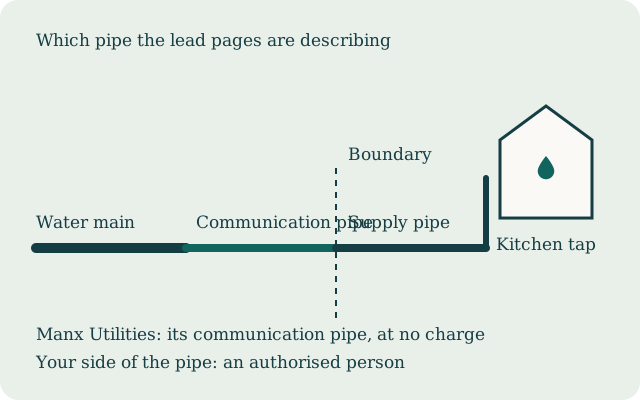
Lead pipe replacement (read 17 October 2026) says that if you have lead pipes and wish to replace them, contact an authorised person to replace the supply pipe into the property. “You can then request” that Manx Utilities replace the existing lead communication pipe, “free of charge.” While the pipes in the home are being removed, it says to replace the earth leakage strap. Without that strap on the new pipe, “you might compromise your electrical safety.” If in doubt, it says to ask a registered electrical contractor. The page does not say what the strap looks like, and this note does not add a wiring diagram. The form does not mention the strap.
application form for lead service replacement (read 17 October 2026) is the one-page PDF linked from that page. The file opened on 17 October 2026. The form prints “Form LSP 12.05.2021” and the title “APPLICATION FOR LEAD PIPE REPLACEMENT.” It says the form must be returned “before any work commences on the service pipe”, to Manx Utilities, P O Box 177, Douglas, Isle of Man, IM99 1PS. The declaration on the same form is that the lead supply pipe has already been replaced, and it requests replacement of the communication pipe. The page’s “you can then request” and the form’s “before any work commences”, read with a declaration that the supply pipe has been replaced, are both printed. This note does not invent a third sequence.
The form says there is “no charge for the work carried out by Manx Utilities”, and that an authorised person must be contacted for “my/our side of the pipe.” Mains and fittings laid “shall remain the property of Manx Utilities and be under its sole control.” It says the signer will ensure that “the contactors’ certificate” — that spelling is on the form — is sent to Manx Utilities before any work is backfilled, “in accordance with Bylaw 8(1) of the Water Supply byelaws 2002.” It prints byelaw 7(1) from the Water Supply Byelaws 2002: “No person shall for reward install, alter or disconnect any water fitting unless he is entered in a list kept by the Authority for the purpose of these Byelaws.” The form does not print the list. This note does not have it, and it has not opened the byelaws beyond the extract on the form.
Manx Utilities “will endeavour to carry out the work within 28 days of being notified that the lead pipe has been replaced, although this timeline cannot be guaranteed.” The new boundary box “must be agreed in advance”, and it will not work on or near the boundary “unless it is deemed safe to do so.” Under the office-use block, the form also prints: “In consideration of this payment Manx Utilities will install new water mains and other works which may be deemed necessary to provide the above requested service.” No amount is printed next to that sentence. The declaration higher up says there is no charge for Manx Utilities’ work. This page does not turn the office-use sentence into a price.
The Inspectorate’s page draws the same sort of line, in its own names. The communication pipe, from the main to the outside stop valve, belongs to the water company. The supply pipe, from that valve to the house, belongs to the owner. Plumbing inside the home, to the kitchen tap, belongs to the owner. It recommends a qualified plumber, “for example one who is accredited through the WaterSafe scheme”, and it says to notify the water company because they are “legally required” to replace a lead communication pipe if it is at risk of adding to the lead in the supply. That legal sentence is the Inspectorate’s. The Island pages say “free of charge” and “no charge”, and “an authorised person.” They do not name WaterSafe. This note does not put WaterSafe on the Island list the form mentions but does not print.
The Inspectorate also says that someone buying a property should ask the surveyor to check the outside and inside pipes, “making special mention of lead”, and that purchasers increasingly put the cost of removing lead pipes into the price negotiation. The Manx lead page does not say that. A private well or borehole is outside both the lead page and the form. Sampling for that supply is the subject of Private wells and boreholes on the Isle of Man.
Short answers, same sources.
Do Isle of Man houses still have lead pipes?
Lead pipe replacement (read 17 October 2026) says approximately 33% of the Island’s existing 33,000 service and supply pipes are believed to be lead, commonly from the mid to late 20th century. A home modernised since 1970 is likely to have had the original lead pipework replaced. A property built after 1970 ought not to have any. That is the page’s belief and its “ought not”, not a survey of one house, and not a count for a named town.
How can I tell if a pipe is lead?
On the Manx page, unpainted lead is dull grey and quite soft, and a gentle knife scrape shows shiny silver metal. Check the pipe to the kitchen tap and the pipe from the outside stop tap, whose cover is usually on the pavement. The Inspectorate’s page, which is not an Isle of Man rule, says to scrape with a coin, to wear disposable gloves, and not to breathe in the dust, and it mentions a swollen joint. The two checks are not combined here into one instruction.
Is the lead test free, and is replacement of the company pipe free?
The lead page says there is no charge for a sample taken at a home where you have found lead pipes, and that replacement of its lead communication pipe is free of charge once you have an authorised person replace your supply pipe. The form linked from that page, read the same day, says there is no charge for the work Manx Utilities carries out, and that you must contact an authorised person for your side. It also prints an office-use sentence about “this payment”, with no amount. This page does not invent a fee. The customer’s own plumber is not priced here.
What should be run off before drinking?
The Manx page says at least a bucket from the kitchen tap, more if the pipe exceeds more than 30 yards, then at least 30 seconds run vigorously. It also says never to drink from bathroom taps, lead pipes or not, because of a possible loft tank. The Inspectorate says a washing-up bowl is normally enough, to watch for cooler mains water, and to flush for at least 10 minutes after work on a lead pipe. Its “will protect you and your family” sentence is about that short-term flush, and the same paragraph says the pipes should be replaced as soon as possible.
Does 10 micrograms per litre mean my tap passed?
No. The lead page says the maximum admissible concentration should be 10 micrograms per litre, and that lead can sometimes be above the suggested standard. It does not print your address. The 2025/26 zone samples are a separate document, already described in the mains article from a reading on 13 October 2026, and this note does not re-read that PDF. A passed zone table is not the free test of a house with lead pipes. The England 2024 summary’s sentence that WHO has declared no safe level of lead is that summary’s sentence, not an Island result, and no separate WHO page was opened for this note.
Will a home water filter deal with lead pipes?
These pages do not say that. They do not name a cartridge, a jug or a reverse-osmosis unit. The steps they do give are the flush, the free test, and replacement of the pipe. No model has been selected for Manx Pure Water, so no lead reduction is claimed. A filter for chlorine taste is a different question, on kitchen filters and in the mains article.
Does this cover a private well, or the phone number for Manx Utilities?
No. The lead page and the form are about service and supply pipes on the public supply. A private well or borehole is a different supply, in Private wells and boreholes on the Isle of Man. The lead page prints no telephone number. The form gives P O Box 177, Douglas, Isle of Man, IM99 1PS. Numbers on the contact page are quoted in If tap water looks or tastes different. An enquiry on this website is not the free test and not that form.
Read on 17 October 2026.
Every pipe count, concentration, health sentence and replacement step above is taken from the pages below. They were read on 17 October 2026. Where the Manx page says a knife and the Inspectorate says a coin, where one flush is a bucket and the other a washing-up bowl, and where the form says both “no charge” and “this payment”, both wordings are kept. The 2025/26 report is not re-read here. Its lead row remains in the mains article. Manx Pure Water is independent of Manx Utilities, the Drinking Water Inspectorate and the World Health Organization. Nothing here certifies a product, states a plumber’s price, or reports a sample from a house.
- Manx Utilities: Lead pipe replacement — about 33% of 33,000 service and supply pipes believed to be lead; the 1970 wording; orthophosphate and around 30%; 10 micrograms per litre; the free home test; the bucket, the 30 yards and the bathroom taps; free replacement of the communication pipe; the earth leakage strap
- Manx Utilities form LSP, dated 12.05.2021 on the form: return address P O Box 177; no charge for Manx Utilities’ work; authorised person; byelaw extracts as printed; 28 days, not guaranteed; the office-use “payment” sentence, with no amount
- Drinking Water Inspectorate: Lead in Drinking Water — age of the home, the coin check, the washing-up bowl, the 10-minute flush after work, orthophosphate, the kitchen-tap test, who owns which pipe, WaterSafe as its example, and the health sentences. Not restated here as Isle of Man law
- Drinking Water Inspectorate: Lead in water, Chief Inspector’s 2024 summary for England — the printed sentence that WHO has declared there is no safe level of lead in drinking water. England sample counts and the 2050 ambition on that page are not restated here
The Manx mains water article is the sourced account of the 2025/26 lead samples. The Manx water guide is the service overview. This note is only the lead-pipe question.